
From Brain Science to Social Action: Launching the GSPA×WHIS Brain Health Social Prescribing Initiative (2027–2029)
25 November 2026
Jump to
From Brain Science to Social Action: Launching the GSPA×WHIS Brain Health Social Prescribing Initiative (2027–2029)
The Global Social Prescribing Alliance (GSPA) launched in 2021 by the UK Secretary of State for Health and Social Care and powered by the World Health Innovation Summit (WHIS) is pioneering a novel clinical pathway for preventive brain health, cognitive fitness, and psychological wellbeing.
Through the GSPA-WHIS Brain Health Initiative (2027–2029), we are bridging cutting-edge clinical research with scalable community interventions. By integrating Neuroscience-Informed Psychoeducation (NIPE) into Social Prescribing (SP)—an innovative combined framework known as SP-NIPE—this initiative turns brain awareness into action, empowering individuals to take a proactive role in their neurological and emotional health.
Bridging Neuroscience and Community Care Conventional healthcare systems often struggle to address the non-clinical determinants of cognitive decline, chronic stress, and mental health challenges. SP-NIPE addresses this gap by combining mechanistic brain education with community-based health interventions.
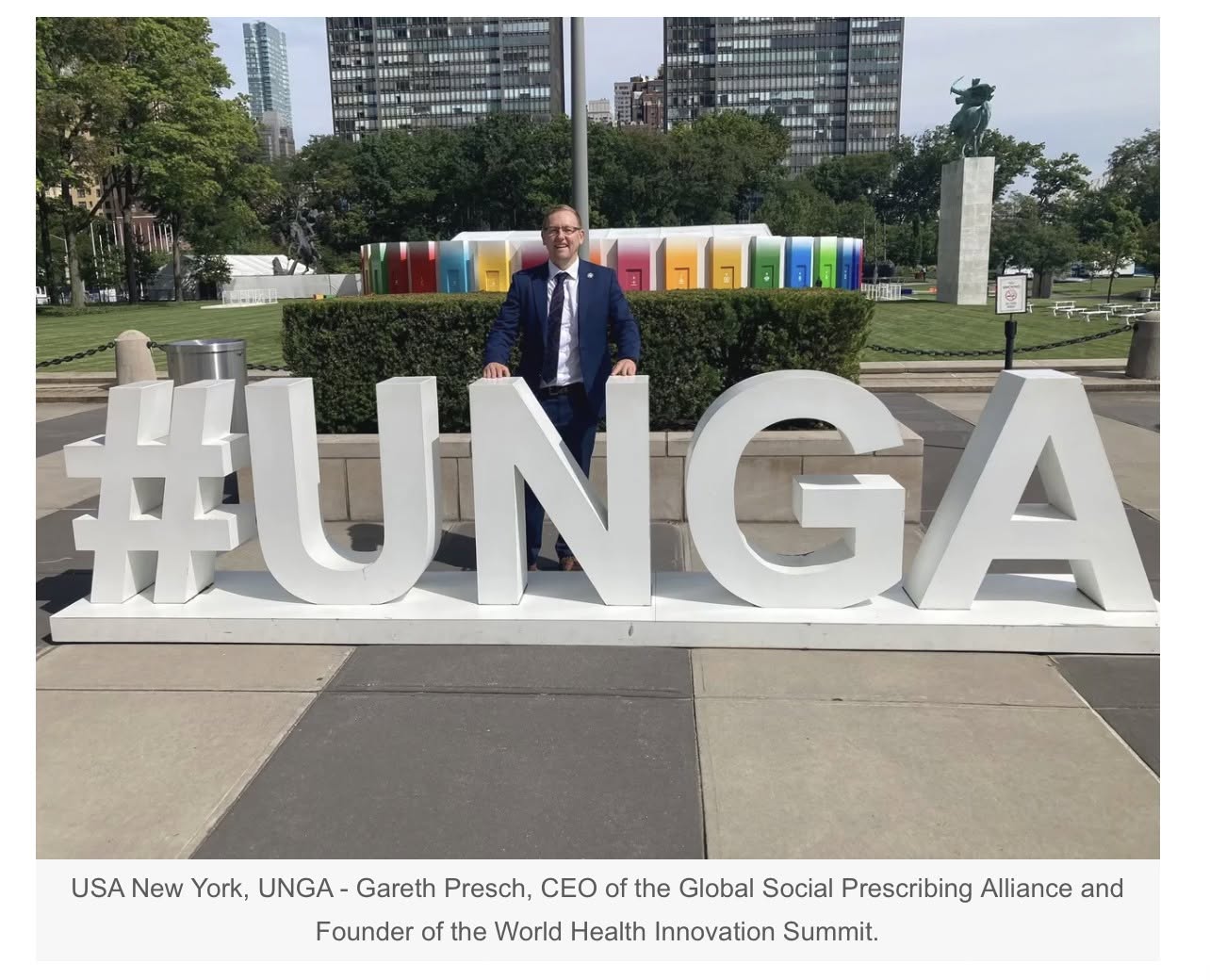
“When the Global Social Prescribing Alliance was launched in 2021, our vision was to establish social prescribing as a global foundation for holistic, person-centred healthcare,” says Gareth Presch, Founder & CEO of WHIS and CEO of GSPA. “With the Brain Health Social Prescribing Initiative, we are building new clinical pathways that translate neuroscience directly into community action. True health isn’t built in isolation—it is cultivated through purpose, social connection, and community empowerment. By scaling SP-NIPE globally, we are giving healthcare providers, employers, and educators the tools to prescribe a life, not just medicine.”
“Understanding how the brain adapts, learns, and heals is one of the most powerful catalysts for personal health transformation,” explains Dr. Mohammad Nami, Neuroscientist and Scientific Co-Author. “NIPE provides the scientific ‘why’ by demystifying neural mechanisms and self-regulation. Social prescribing then provides the practical ‘what and where’—connecting individuals to neuroplasticity-promoting activities like creative arts, physical movement, and social engagement. Together, they create a structured, empowering pathway for brain recovery and resilience.”

Purpose & Impact The GSPA×WHIS Brain Health Initiative operates across two core objectives:
- Scientific & Clinical Impact: Translating brain awareness into enhanced health literacy, self-management, cognitive resilience, and sustained social participation.
- Institutional Adoption: Enabling healthcare systems, academic institutions, corporate employers, and community organizations to implement the framework and achieve GSPA recognition.
The Scientific Foundation The SP-NIPE framework is grounded in established neuroscience and peer-reviewed clinical evidence, as highlighted in the publication Neuroscience-informed psychoeducation (NIPE): How brain awareness supports brain recovery (Progress in Brain Research, Elsevier, 2026).1 The framework focuses on five core pillars of brain health:
- Neuroplasticity & Learning: Encouraging lifelong learning, creative arts, and cognitive skill acquisition to stimulate neural growth.
- Sleep & Circadian Health: Providing sleep hygiene education, routine optimization, and circadian rhythm alignment.
- Stress & Emotional Regulation: Incorporating mindfulness, nature-based interventions (green/blue prescribing), and peer support groups to regulate nervous system function.
- Cognitive Reserve & Healthy Ageing: Supporting intergenerational programs, volunteering, and community clubs to protect cognitive function over time.
- Social Cognition & Connection: Fostering group participation, meaningful relationships, and a sense of belonging to reduce isolation and cognitive risk.
The Clinical-to-Community Pathway The SP-NIPE model standardizes the transition from clinical assessment to community integration through a 5-step process:
01. PROFILE ➜ 02. EDUCATE ➜ 03. PRESCRIBE ➜ 04. ENGAGE ➜ 05. REVIEW- 01. Profile: Initial brain health and lifestyle profiling.
- 02. Educate: A focused 15–30 minute NIPE session explaining the neural mechanisms behind symptoms and recovery.
- 03. Prescribe: Personalized referral to community-based activities facilitated by a Link Worker or Community Connector.
- 04. Engage: Active participation in tailored social prescribing activities.
- 05. Review: Follow-up evaluations at 6 and 12 weeks to measure cognitive, emotional, and social outcomes.
The Core Formula: NIPE provides the why. Social prescribing provides the what and where. The link worker establishes the how.
04. Institutional Entry Points To facilitate global adoption, the initiative provides ready-to-deploy implementation kits customized for key sectors:
- Hospitals & Networks: 90-Day Brain Health Social Prescribing Platform
- Clinics & Outpatient Care: Brain Health Practice Starter Kit
- Universities & Schools: Brain-Healthy Campus Program
- Employers & Industry: Brain-Healthy Workplace Initiative
05. Implementation Roadmap & 3-Year Ambition Starting in December 2026, the GSPA×WHIS steering committee will execute a phased rollout:
- Months 1–3 (Establish & Engage): Form steering groups, publish concept notes, engage founding institutional partners across Europe, North America, and the GCC region, and host public webinars and roundtables. (In alignment with our organizational playbooks, initial phases prioritize awareness raising to build long-term sustainability).
- Months 4–7 (Pilot & Showcase): Launch 3–5 active institutional pilots, train 30–50 healthcare professionals, and showcase preliminary outcomes at the Global Social Prescribing Summit on 9 July 2027.
- Months 8–12 (Scale & Quality Mark): Expand international partnerships, support GSPA Quality Mark applications, and publish pilot case studies.
Strategic 3-Year Horizon:
- 2027 (Prove): Validate the SP-NIPE model and evaluate pilot outcomes.
- 2028 (Scale): Expand institutional adoption, regional chapters, and clinical research.
- 2029 (Embed): Formally integrate SP-NIPE into international clinical guidelines, corporate health standards, and routine patient care pathways.
Get Involved Whether you represent a healthcare provider, university, enterprise, or community organization, you can join the movement to shape the future of preventive brain health.
- Join the Alliance: https://whis.world/programs/gspa/
- Read the Research: Citing the scientific foundation published in Progress in Brain Research (2026)
Contact: info@whis.world
Older story → Announcing Jayeeta Poddar Choudhury as Co-Chair for the Global Social Prescribing Alliance’s "Social Prescribing Around the World" Initiative