
Jump to
Bravo to Ethiopia’s health minister, Mekdes Daba. On 23 November, at Africa CDC’s Ministerial Dialogue with Candidates for Director-General of WHO in Addis Ababa, she asked the best question of the race so far. It yielded the biggest crop of potential health targets yet. This was her question:
“If you’re asked to deliver three things before you go to be a Director-General of the WHO, what are the three promises, key promises, that you will give and deliver for Africa? I’m asking as a daughter of Africa, another mother who wants to see a change for the continent and the next generation.”
Before I turn to the answers, some background. I have been following the WHO DG election using my “more results, less politics” scorecard. It has seven domains: four on results and three on politics. The key is checkable commitments, such as dated targets or mechanisms (these get two dots), because these give member states something to hold a DG accountable for, and clarify what the candidates plan to deliver and how.
Two candidates said something in Addis that earned them a second dot:
- Budi Gunadi Sadikin, on measurement.
- Hans Kluge, on innovation and finance.
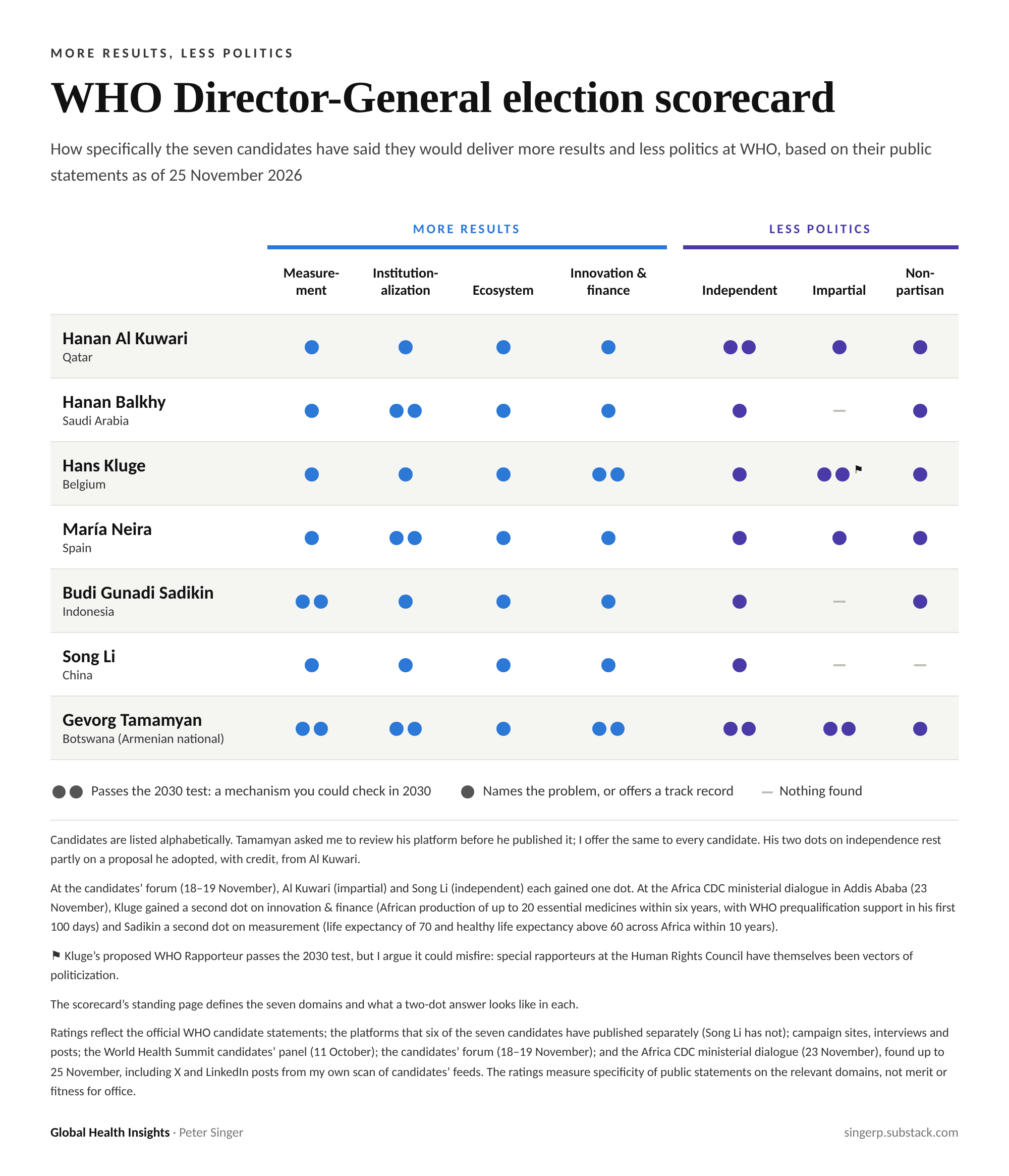
This post is about the Minister’s question, the targets it produced, and what would make them checkable, including WHO’s own contribution. It ends with how member states can ask for the missing pieces before the Executive Board’s nomination of up to three candidates in late January. It also covers what else stood out in Addis, using the “more results, less politics” framework of my scorecard.
More results
Measurement
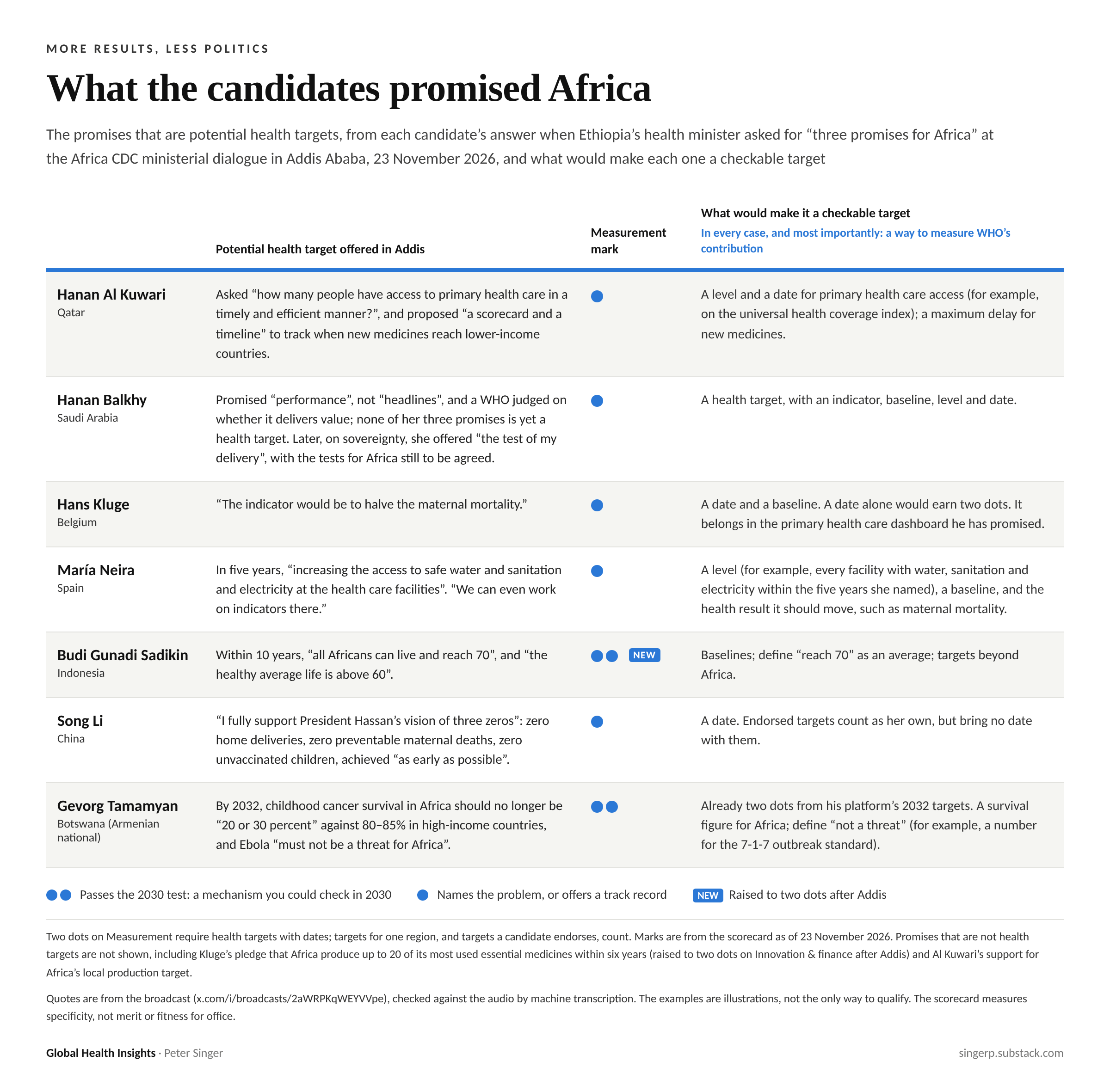
Minister Daba’s question elicited a range of responses, which are well covered in this Health Policy Watch article. In the figure below, I focus on the responses that are potential health targets. I call them potential targets because most lack a date or a measurable level. Only Sadikin’s response earned two dots in Addis (an actual target and a date); Tamamyan’s 2032 answer echoed the targets in his platform, which had already earned him two dots. Sadikin’s target uses a measure WHO already tracks: healthy life expectancy was the highest-order outcome in the measurement framework of WHO’s 13th General Programme of Work (GPW 13), its strategic plan, and it remains so in the current GPW 14. On my scorecard, a health target with a date is enough for two dots on measurement; a results dashboard also needs a baseline and WHO’s contribution. The figure also shows how all the responses could be turned into actual health targets.
Institutionalization
The promises now have an audience that says it will check them. Closing the session, Africa CDC’s Director-General, Jean Kaseya, said: “We took note of their three commitments for Africa and will make them accountable.” Minister Daba had already put the candidates on notice: “I’m sure a team from here will follow up and will listen to what have you promised before you get to be a DG for WHO.”
Ecosystem
Asked how to end fragmentation, Kluge offered “one plan, one budget, one report.” When Namibia’s health minister, Esperance Luvindao, pressed for “practical ways… that we have not heard before,” Neira proposed starting from functions rather than institutions. No one offered metrics.
As I wrote after the Geneva forum, each new reform process tends to bury the previous one, without achieving much. And again, no one mentioned the survey from the SDG3 Global Action Plan, in which member states rated agencies on how well they followed national priorities and how well they worked together. That survey would be useful today.
Innovation and finance
Kluge’s promise on medicines came from the same three-promises question: “Within six years, with the leadership of the African Medicines Agency, Africa to produce up to 20 of its most used essential medicines.” He added WHO prequalification support in his first 100 days. Because it is about production, I score it here rather than in the figure above, and it earned him a second dot. Al Kuwari backed Africa’s own goal for local production, but without a date of her own: “I intend to work to help you reach your target of 70% or 90% of the medicine produced locally.” (The target African leaders reaffirmed in February is at least 60% of health products by 2040.)
On finance, the answers were about convening, and Sadikin made the case most fully. He returned several times to his 30 years in banking and told ministers that “the money is out there.” Many health ministers, he said, fail to convince their own finance minister, so WHO should help each country build a single national plan and bring in development banks such as the African Development Bank and the World Bank to make the case. Nobody mentioned WHO’s existing Health Impact Investment Platform, which already brings development banks together to finance primary health care.
Less politics
Independent
South Africa’s health minister, Aaron Motsoaledi, who moderated, asked the candidates: “Can you confirm you are under oath now?” He wanted them to confirm that they would hold firm even if the biggest donor said it was taking its money out tomorrow. Neira said, “Definitely, yes, I will stand.” Tamamyan said, “Of course I do.” Balkhy said she would “continue to speak science, support science, no matter what the cost is,” and Al Kuwari said, “I do not give in to bullying.” Song Li began with “Yes,” then immediately spoke about working with partners, mobilizing resources and providing evidence. Earlier she had told the room: “For WHO, we serve for all member states, not only several member states.” Kluge offered a track record. In Myanmar and North Korea, he said, he refused to give in, and “the donor left… We found six other donors, and we saved 120,000 tuberculosis patients.” But no one named a mechanism to protect WHO’s independence. Al Kuwari’s platform has one: extending the remit of WHO’s Independent Expert Oversight Advisory Committee to cover the independence of WHO’s scientific advice, “with its findings published in full.”
Impartial
Asked about verified attacks on health care “with zero accountability from WHO,” Kluge set out four steps, including “a special rapporteur to report to the WHO Executive Board,” an idea from his manifesto that I think could misfire. None of his steps, and no other candidate, addressed the militarization of health facilities. The Center for Medical Integrity has made good recommendations on this, including recording prior military use of a facility when an attack is reported.
Non-partisan
Sadikin told the room that “the world that I know is 194 countries—no, 192 countries,” a self-correction that may have been a nod to the departures of the United States and Argentina. Kluge was the only candidate to speak about them: “A WHO with empty chairs is a weak WHO for all of us.” But again, no candidate offered a roadmap for addressing US concerns.
Beyond the scorecard
Beyond the scorecard, the main issue in Addis was geopolitics. Africa’s 54 member states make up more than a quarter of the World Health Assembly. In my experience, in 2017 they held together behind Tedros, the African Union’s endorsed candidate. This time no candidate is African, and Africa CDC brought all seven to Addis so that, as Kaseya put it, “our ministers, they will know how to make their choice when they will be in Geneva.”
The clearest bid for that bloc came from Kluge, WHO’s Regional Director for Europe: “My formal commitment to you, Excellency, is if I’m Director-General, the WHO Deputy Director-General will be from Africa.” He also promised four young people from Africa’s Anglophone, Francophone and Lusophone subregions in the Director-General’s office at any time, and, within his first 100 days, a council of elders from Africa. Not all the reactions I heard welcomed these offers, however, given the history of relations between Europe and Africa.
For Song Li, the biggest question in my mind is the same as after Geneva: whether the diplomatic muscle of one of the world’s two superpowers, China, is enough to put her in the top three. In Africa, that muscle is considerable. China is the continent’s largest trading partner, with trade at a record $348 billion in 2025. Nobody mentioned China by name, and whether its economic weight on the continent turns into African votes for Song Li is the kind of geopolitics that happens out of public view.
From promises to a dashboard
The Minister’s question was half a dashboard question. It asked what the candidates would deliver. A dashboard also asks by when, from what baseline, and, most importantly, what WHO itself will contribute. The second figure above shows how far each answer is from that.
Member states can ask for the other half. In my post after the Geneva forum, I suggested a question they could put to every candidate through WHO’s web forum, which is open until 20 December, ideally jointly and across regions:
Please publish a prototype results dashboard for your first term. It should answer these questions. Which three to five health results would WHO help countries achieve, with an indicator, baseline and target for each? How would you use the universal health coverage index and the 7-1-7 target for emergency preparedness? Would you adapt WHO’s existing delivery dashboards, improve on them or replace them, and how would you reduce the almost 200 indicators in WHO’s current results framework? How would you measure and manage WHO’s own contribution, and how would country-owned targets roll up to assess the performance of WHO, and of the Director-General? And how would the dashboard form the core of an investment case, so that member states and funders know what they are buying?
As Sadikin told the room, “As a banker, I realize that it’s very easy to give promise, but very difficult to keep it.” Africa asked for promises. A dashboard is how it will know they are kept.
Disclosures: I wrote this blog. I used AI (Claude, Anthropic) for research assistance and editing. The arguments, judgments and conclusions are my own, and I take full responsibility for them. I was on Dr. Tedros’s 2017 campaign team, which is the basis of my comment on Africa’s vote that year, and then Special Advisor to the Director-General and an Assistant Director-General; I have no role in any current campaign. I knew four of the candidates from WHO before the race began, and worked closely with Balkhy. At his request, I reviewed Gevorg Tamamyan’s platform before he published it. I offer the same to any candidate. The SDG3 Global Action Plan survey and WHO’s 13th General Programme of Work, which I mention, were part of my own work at WHO, and the roadmap link is to my own New York Times article. I am not endorsing any candidate, but I am endorsing the idea that member states should select candidates who promise more results and less politics.
P.S. After the Geneva forum, I turned the dashboard question into a song, “Where Are the Results?” It’s fun and you might enjoy it. The song was made with Suno.
Older story → More Results, Less Politics: Spotlighting Peter Singer’s Global Health Insights and Health Matters Episode 6